
Is Custom Fleet Upfitting Worth the Investment

Table of Contents
- What Custom Fleet Upfitting Delivers
- Commercial Fleet Upfitting ROI: Measuring the Return
- Fleet Upfitting Checklist: Planning Your Investment
- Commercial Van Shelving and Storage: Efficiency at Work
- Fleet Upfitting Safety Upgrades: Protecting Your Team
- The Hidden Costs of Skipping Custom Upfitting
- Making the Decision: Is It Right for Your Fleet
- Frequently Asked Questions
Last Updated: October 12, 2026
What Custom Fleet Upfitting Delivers
Custom fleet upfitting is the process of configuring work vehicles with specialized storage, safety features, and equipment tailored to your business operations. Unlike stock vehicles that come with generic interiors, a properly upfitted fleet transforms each truck or van into a mobile workspace designed around your specific workflow.
At Purpose Built Automotive in Dallas, GA, we've worked with fleet managers and business owners across multiple industries. The difference between a vehicle that works and one that's optimized for your operation is substantial. A landscaping truck with organized tool storage cuts job-site setup time by half. A service vehicle with integrated shelving means technicians spend less time hunting for parts and more time on billable work. A delivery van with climate-controlled storage protects inventory from weather damage that would otherwise cost thousands in replacements.
The real question isn't whether upfitting adds value. It's whether that value justifies the upfront investment. That depends on your fleet size, vehicle lifespan, and how intensively you use those vehicles.
Commercial Fleet Upfitting ROI: Measuring the Return
Return on investment for custom fleet upfitting breaks down into three measurable categories: labor efficiency, asset protection, and operational reliability.
Labor efficiency is the most direct metric. When your team spends less time organizing tools, searching for equipment, or loading and unloading vehicles, those hours convert to billable work or reduced overtime. A technician who saves 30 minutes per day across a five-day week recovers 2.5 hours. Over a year, that's 130 hours. For a service business, that translates into additional revenue or lower labor costs.
Asset protection matters more than most fleet managers initially recognize. Tools left loose in a truck bed get damaged or lost. Inventory exposed to temperature swings deteriorates. Equipment bouncing around during transit fails prematurely. Custom shelving, secure storage compartments, and climate considerations keep your assets intact. The cost of replacing a single high-value tool or inventory loss often exceeds the cost of upfitting that vehicle.
Operational reliability is the third factor. A well-organized vehicle reduces driver stress, improves safety, and makes it easier to hand off vehicles between team members. When a new technician can walk up to a vehicle and immediately understand where everything is stored, onboarding becomes faster and mistakes become less likely.
Research from Element Fleet Management's guidance on upfitting processes emphasizes that the decision goes beyond comparing vendor quotes. The true measure is whether the upfit enables your team to work more efficiently, protect your assets, and maintain consistent operations over the vehicle's working life.
Fleet Upfitting Checklist: Planning Your Investment
A successful upfitting project starts with a clear understanding of what your vehicles actually need to accomplish.
Begin by auditing your current workflow. What tools, equipment, or inventory does each vehicle carry? How is it currently stored? What problems occur most frequently? A delivery driver might need climate-controlled compartments and easy access to frequently used items. A service technician needs organized tool storage and secure compartments for expensive equipment. A landscaping crew needs heavy-duty racks and secure fastening for power equipment.
Next, define your vehicle's working life. A fleet vehicle typically operates for 5 to 10 years before replacement. Upfitting costs are spread across that entire period. A vehicle replaced in three years means your upfit investment never fully amortizes. A vehicle kept for eight years means the per-year cost becomes much more reasonable.
Consider scalability. If you're upfitting five vehicles, you might use one approach. If you're upfitting 50 vehicles, standardization becomes critical. Standardized upfits reduce training time, simplify maintenance, and make it easier to move equipment between vehicles when needed.
Document your specifications before contacting upfitters. The more detail you provide about what each vehicle needs to accomplish, the more accurate your quotes and timelines become. Purpose Built Automotive's team works with fleet managers to translate operational requirements into practical upfitting plans.
| Planning Element | What to Define | Why It Matters |
|---|---|---|
| Current workflow | Tools, equipment, storage patterns | Identifies actual needs vs. assumed ones |
| Vehicle lifespan | Typical years in service | Determines how long upfit costs amortize |
| Team size | Number of vehicles to upfit | Affects standardization and timeline |
| Safety requirements | Regulatory or industry standards | Ensures compliance and liability protection |
| Budget constraints | Total investment available | Helps prioritize features and phasing |
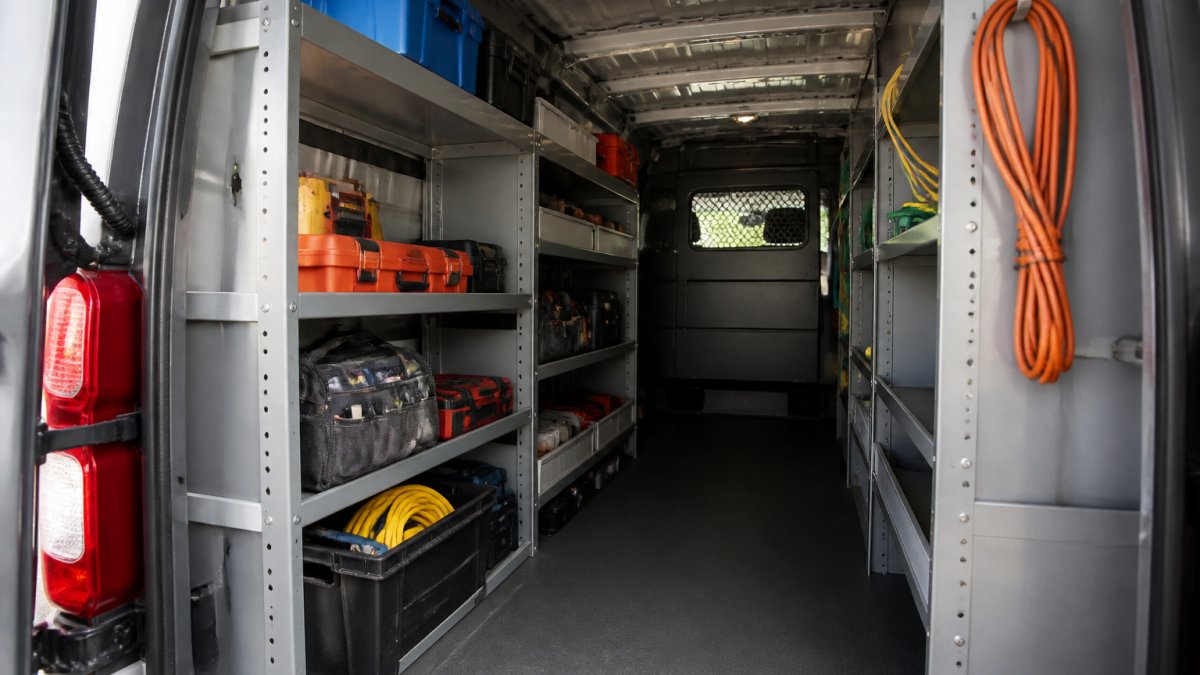
Commercial Van Shelving and Storage: Efficiency at Work
Shelving and storage are the foundation of fleet upfitting. They transform wasted space into organized, accessible inventory.
The choice between fixed shelving, modular systems, and specialized racks depends on what you're storing and how often you access it. Fixed shelving maximizes space but requires careful planning because it can't be reconfigured later. Modular systems cost more initially but allow you to adjust your layout as your business evolves.
Weight distribution matters more than most people realize. Overloading one side of a van affects handling, tire wear, and fuel efficiency. Professional upfitters calculate weight distribution and position heavy items low and centered. A poorly balanced van becomes harder to drive, wears tires faster, and uses more fuel over its lifetime.
Accessibility is the operational difference between an upfit that works and one that doesn't. The items your team uses most frequently should be easiest to reach. Items used occasionally can go higher or deeper. The worst upfits force your team to move other items just to access what they need. The best ones keep your most-used inventory at waist height with clear sightlines.
Fleetio's vehicle upfitting guidance highlights that the difference between upfront cost and the cost of a layout over time is significant. An inexpensive shelving system that requires constant reorganization costs more in labor inefficiency than a well-designed system that maintains its organization.
Fleet Upfitting Safety Upgrades: Protecting Your Team
Safety upgrades are often treated as optional add-ons. They're not. They're investments in liability protection and team wellbeing.
Proper tie-down systems keep tools and equipment from becoming projectiles during sudden stops or accidents. Loose items in a moving vehicle are hazards. Secured items are controlled. The difference between a tool rolling around in the back and a tool that's properly secured can be the difference between a minor incident and a serious injury.
Lighting upgrades extend the working day and improve visibility in dark work environments. A service technician working under a vehicle needs adequate lighting to work safely. A delivery driver loading a van in early morning darkness needs to see what they're doing. LED lighting systems are energy-efficient and provide better illumination than older systems.
READY TO BUILD YOUR DREAM TRUCK? →
Step boards, grab handles, and entry assists reduce fall risk. Your team is entering and exiting vehicles multiple times per day. Making those transitions safer reduces injuries and workers' compensation claims.
Ventilation and climate control protect your team in extreme weather. A technician working in a van during summer heat needs air circulation. A delivery driver in winter needs to protect inventory from freezing temperatures. Climate-controlled compartments also protect temperature-sensitive inventory from degradation.
According to Auto Trim Group's analysis of custom fleet upfits, safety upgrades are often the most cost-effective upfitting investments because they reduce both injury risk and inventory damage simultaneously.
The Hidden Costs of Skipping Custom Upfitting
Businesses that run fleet vehicles without proper upfitting face costs that don't appear in any budget line but accumulate over time.
Labor inefficiency is the first hidden cost. Your team spends time organizing, searching, and retrieving items instead of performing billable work. Over a year, this adds up to hundreds of hours of lost productivity. For a service business, that's revenue left on the table. For an internal operation, it's overtime and scheduling complexity that could be avoided.
Equipment damage and loss is the second hidden cost. Tools left loose in truck beds get damaged or lost. Inventory exposed to weather deteriorates. Equipment that bounces around during transit fails prematurely. A single major loss often exceeds the cost of upfitting that vehicle.
Liability and compliance is the third hidden cost. Unsecured loads can shift during transit, affecting vehicle handling and creating accident risk. Inadequate lighting or ventilation creates safety hazards. If an accident or injury occurs and your vehicle lacked basic safety equipment, your liability exposure increases significantly.
Inefficient operations is the fourth hidden cost. Without standardized storage, new team members spend time figuring out where things are. Vehicle maintenance becomes inconsistent because different drivers organize things differently. Handoff between drivers creates confusion. These operational friction points compound across a fleet.
The comparison isn't between upfitting and no upfitting. It's between the upfront investment in upfitting versus the accumulated costs of inefficiency, damage, and liability that you're already paying through other channels.
Making the Decision: Is It Right for Your Fleet
The decision to upfit your fleet comes down to three factors: your vehicle lifespan, your operational intensity, and your current pain points.
If your vehicles are typically replaced within three years, upfitting ROI becomes harder to justify because costs don't amortize over enough time. If your vehicles stay in service for seven to ten years, upfitting ROI improves significantly because those benefits compound over a longer period.
If your fleet vehicles are used occasionally or lightly, the labor efficiency gains are smaller. If your vehicles are in constant use with high demands, upfitting delivers more immediate and obvious returns.
If your current operations run smoothly with minimal downtime, lost tools, or inventory damage, upfitting is a nice-to-have improvement. If your team regularly loses time searching for equipment, if you experience frequent inventory loss or damage, or if safety incidents occur, upfitting becomes a necessary investment.
Purpose Built Automotive works with fleet managers across Dallas, GA to evaluate these factors and determine whether custom upfitting makes sense for your specific operation.
The real question isn't whether custom fleet upfitting is worth the investment in general. It's whether it's worth the investment for your specific fleet, your specific vehicles, and your specific operational needs. When upfitting aligns with your actual workflow and vehicle lifespan, the ROI becomes clear.
The decision to invest in custom fleet upfitting depends on your vehicle lifespan, operational demands, and current pain points. For most fleet operations in Dallas, GA, the combination of labor efficiency gains, asset protection, and operational reliability makes upfitting a sound investment.
Frequently Asked Questions
What's the typical payback period for custom fleet upfitting?
Payback depends on your operation's specifics: fleet size, vehicle usage intensity, and labor costs. Many fleets see efficiency gains within the first year through reduced downtime, faster job completion, and improved employee productivity. However, the timeline varies. Focus on measuring your own metrics: time saved per job, fuel efficiency improvements, and reduced vehicle wear. Track these against your upfitting investment to calculate your actual ROI.
Will custom fleet upfitting void my vehicle warranty?
Not necessarily. Professional upfitting by experienced installers typically preserves your warranty on the vehicle itself. However, aftermarket components may have their own warranty terms separate from the manufacturer's coverage. Always discuss warranty implications with your upfitter before work begins. Quality installations minimize risk to your manufacturer coverage, which is why working with specialists matters for your long-term protection.
How do commercial van shelving and storage affect safety?
Properly installed shelving prevents tools and equipment from shifting during transit, reducing accident risk and protecting your team. Organized storage also means faster access to safety equipment and supplies when needed. Poor storage can cause distractions, falls, or collisions. Custom upfitting includes securing heavy items, creating safe work zones, and organizing emergency gear, all of which contribute to a safer work environment for your crew.
Can I add upfitting to an existing fleet vehicle, or does it need to be new?
Existing vehicles can absolutely be upfitted. Many fleet owners upfit their current trucks and vans to extend their service life and improve efficiency without replacing the entire vehicle. This approach often delivers faster ROI than waiting for new vehicles. The key is choosing an upfitter experienced with retrofit work on your specific vehicle model and ensuring the upfitting doesn't compromise the vehicle's structural integrity or remaining service life.