
Alternatives to Factory Fleet Vehicle Storage

Table of Contents
- Why Factory Storage Falls Short for Commercial Fleets
- Fleet Vehicle Shelving Systems That Maximize Space
- Work Truck Storage Ideas for Better Organization
- Commercial Van Storage Options for Your Operations
- Vehicle Storage Units for Businesses: When to Go External
- Key Factors to Consider When Choosing Fleet Storage
- Getting Your Fleet Storage Right
- Frequently Asked Questions
Last Updated: October 5, 2026
Why Factory Storage Falls Short for Commercial Fleets
Factory fleet vehicle storage sounds practical in theory. In reality, it's a constraint that limits your business flexibility and often costs more than alternatives. When your fleet grows beyond what the manufacturer designed for, you're stuck paying for space you can't use efficiently or searching for workarounds that waste time and money.
The core problem is that factory storage doesn't adapt to your actual operations. You need solutions that scale with your business, organize your equipment logically, and protect your investment. At Purpose Built Automotive in Dallas, GA, we've worked with fleet managers who realized their factory setup was holding them back. They needed better alternatives to factory fleet vehicle storage that matched how they actually work.
This guide covers practical alternatives that work for businesses of all sizes, from single work trucks to multi-vehicle operations. We'll walk through each option so you can choose what fits your operation best.
Fleet Vehicle Shelving Systems That Maximize Space
Fleet vehicle shelving systems are custom-built storage solutions that fit inside your truck beds, cargo areas, or garage spaces. They use vertical space efficiently and keep tools and materials organized and accessible. When designed properly, these systems reduce clutter, protect equipment from damage, and speed up job site prep.
The key advantage is that shelving systems are tailored to your specific vehicle and workflow. You're not paying for generic factory storage that doesn't match your needs. Instead, you get organized compartments, drawers, and racks positioned exactly where your crew needs them.
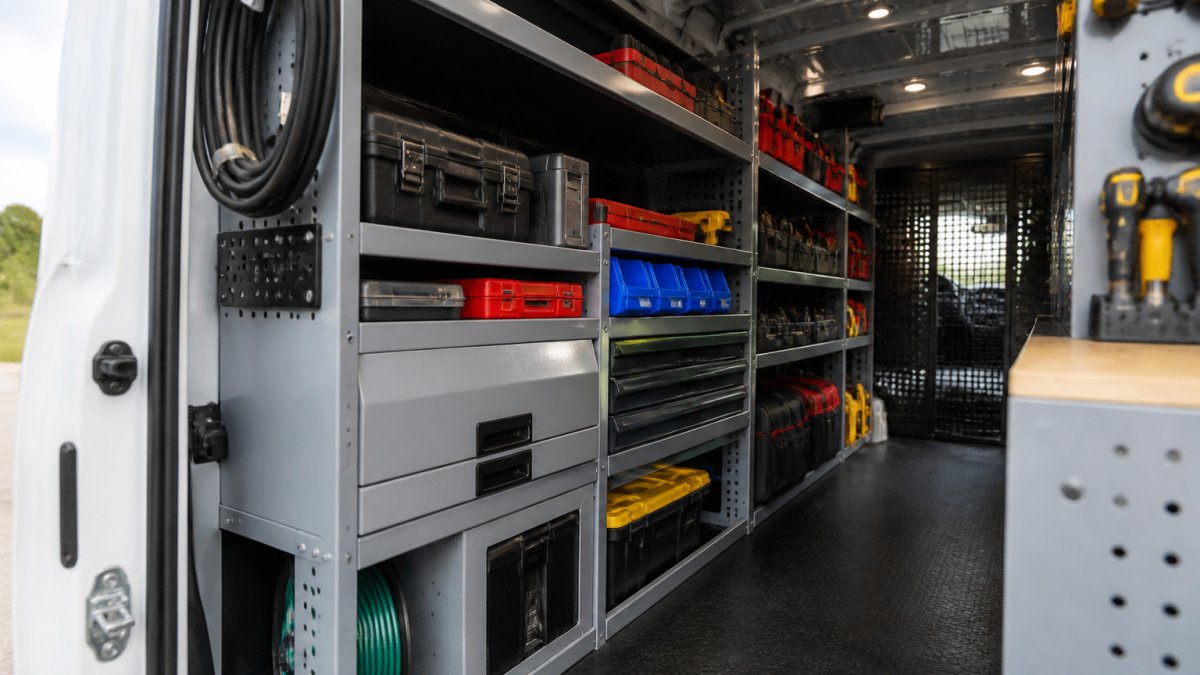
Many fleet managers find that shelving systems pay for themselves within months by reducing lost tools, speeding up job site setup, and minimizing damage to equipment during transport. The systems also make inventory management simpler since you can see what you have at a glance.
Consider whether you need modular systems that can be reconfigured as your needs change, or fixed installations optimized for your current workflow. Modular options offer flexibility if you're still experimenting with your storage layout. Fixed systems tend to be more strong for heavy-duty operations.
Work Truck Storage Ideas for Better Organization
Work truck storage goes beyond shelving to include toolboxes, under-bed drawers, side-mounted racks, and specialized compartments designed for specific equipment. The goal is creating a system where every tool and material has a designated spot and is protected during transport.
Effective work truck storage means your crew spends less time searching for tools and more time on billable work. It also reduces the risk of equipment damage or loss, which directly impacts your bottom line. When tools are organized and secured, job sites run smoother and your team stays more productive.
Different types of work require different storage approaches. A landscaping operation needs different organization than an HVAC service fleet or electrical contractors. The best systems are built around your specific workflow and equipment.
Purpose Built Automotive offers commercial upfitting services that include custom storage solutions tailored to how your team actually works. We can design and install systems that maximize your truck's capacity while keeping everything accessible and protected.
Commercial Van Storage Options for Your Operations
Commercial vans present unique storage challenges because they combine passenger space, cargo area, and equipment needs in a compact footprint. Van storage solutions typically include shelving systems, wall-mounted racks, and floor-mounted compartments that maximize usable space without compromising safety or accessibility.
The advantage of van-specific storage is that it's engineered for the vehicle's dimensions and weight distribution. A poorly designed storage system can affect your van's handling, fuel efficiency, or braking performance. Professional van storage solutions account for these factors.
Many businesses choose between interior shelving systems that maximize cargo space and exterior racks that preserve interior room. Interior systems work best if you need frequent access to tools throughout the day. Exterior storage makes sense if you're primarily transporting materials and only need occasional access.
Vans also benefit from climate-controlled storage considerations if you're transporting temperature-sensitive materials or equipment. Some operations add insulation or ventilation to their van storage systems to protect their inventory.
Vehicle Storage Units for Businesses: When to Go External
External vehicle storage units become necessary when your fleet grows beyond what onboard storage can handle or when you need secure off-site storage for seasonal equipment, backup vehicles, or overflow inventory. These facilities range from simple covered parking to climate-controlled warehouses with security systems.
Going external makes sense when your fleet includes vehicles that sit idle for portions of the year, when you need to store equipment between jobs, or when space constraints at your main location make onboard storage impractical. External units also provide backup capacity for emergencies or seasonal surges in demand.
READY TO BUILD YOUR DREAM TRUCK? →
The trade-off with external storage is convenience and accessibility. You're not storing everything on your vehicle where your crew can grab it instantly. However, the organized facility often compensates by making inventory management and equipment maintenance easier.
When evaluating external storage, consider proximity to your operations base, security features, climate control if needed, and whether the facility offers the flexibility to scale up or down as your business changes. Some facilities also offer maintenance services, which can be valuable for fleet operations.
Key Factors to Consider When Choosing Fleet Storage
Selecting the right fleet vehicle storage solution requires evaluating several factors specific to your operation. Start by assessing your actual storage needs, not what you think you should need. Document what equipment your crew uses daily, what gets transported between jobs, and what needs seasonal storage.
Next, consider your growth trajectory. A solution that works perfectly today might be inadequate in two years. Building in some extra capacity or choosing modular systems that can expand is often smarter than maxing out your current setup.
Security and weather protection matter more than many business owners realize. Equipment left unprotected deteriorates faster and becomes a theft target. The right storage solution protects your investment and keeps your crew safer on job sites.
| Factor | Why It Matters | Consider |
|---|---|---|
| Daily accessibility | Crew efficiency depends on quick tool access | Onboard shelving vs. external storage |
| Equipment volume | Determines whether onboard or external storage fits your needs | Current inventory plus 20% growth buffer |
| Vehicle type | Storage design must match your specific trucks or vans | Customization requirements for your fleet |
| Budget constraints | Storage solutions range widely in cost | Balance upfront investment with long-term value |
| Expansion plans | Growing fleets need scalable solutions | Modular systems vs. fixed installations |
| Security requirements | Theft and weather damage affect total cost | Facility features and vehicle-level security |
Cost is important but shouldn't be the only factor. A cheap storage solution that doesn't organize your equipment efficiently or protect it adequately will end up costing more through lost tools, damaged inventory, and wasted crew time.
Getting Your Fleet Storage Right
The best fleet vehicle storage solution is the one that matches your operation's actual workflow and growth plans. There's no universal answer. What works for a five-truck landscaping company won't work for a 50-vehicle commercial fleet.
Start by being honest about your current storage challenges. Are tools getting lost or damaged? Is your crew wasting time searching for equipment? Are vehicles packed inefficiently? Your answers point toward the right solution.
When you're ready to implement a storage solution, professional installation matters. Poorly installed shelving systems can shift during transport, creating safety hazards and damaging equipment. Properly designed systems stay secure and functional for years.
Purpose Built Automotive in Dallas, GA specializes in commercial upfitting, including custom fleet vehicle storage solutions. Our Fleet Program offers exclusive discounts on storage systems, professional installation, and ongoing support. We design storage solutions around how your team actually works, not around generic assumptions.
Whether you need onboard shelving systems, work truck organization, commercial van storage, or external storage coordination, we can help you find a solution that improves efficiency and protects your investment. Contact us to discuss your fleet storage needs and explore alternatives that work for your business.
Your fleet's organization directly affects your crew's productivity and your bottom line. Factory storage rarely delivers what commercial operations actually need. By exploring alternatives tailored to your specific workflow, you can create a storage system that works harder for your business. At Purpose Built Automotive, we understand the demands of commercial fleets in Dallas, GA, and we're ready to help you build the storage solution that makes your operation run smoother. Reach out today to learn how our commercial upfitting expertise can transform how you manage your fleet.
Frequently Asked Questions
What are the main alternatives to factory fleet vehicle storage?
The most practical alternatives include aftermarket shelving systems installed inside vehicles, commercial storage units at a separate facility, mobile storage trailers, and hybrid approaches that combine in-vehicle organization with external backup storage. Each option serves different business needs depending on fleet size, equipment volume, and operational workflow. Many fleet managers use a combination of these solutions to maximize efficiency and accessibility.
How can fleet vehicle shelving systems improve work truck storage?
Fleet vehicle shelving systems organize tools and equipment vertically, reducing clutter and making items instantly accessible. Custom shelving units maximize interior space, protect equipment from damage during transit, and reduce time spent searching for tools on job sites. Proper organization also improves vehicle safety by securing loose items and preventing driver distraction. Professional installation ensures systems are engineered for your specific truck model and load requirements.
Should businesses use external storage units or in-vehicle storage?
The choice depends on your operational model. In-vehicle storage works best for mobile crews that need immediate access to tools throughout the day. External vehicle storage units for businesses make sense when you have a central hub, need to store seasonal equipment, or manage overflow inventory. Many fleet managers use both: essential daily tools stay in the truck, while backup stock and seasonal items go to external storage, reducing vehicle weight and improving fuel efficiency.
What safety features should fleet storage systems include?
Critical safety features include secure tie-down points to prevent shifting cargo, proper weight distribution to maintain vehicle handling, lockable compartments to protect tools and materials, and clear sightlines to avoid driver obstruction. Systems should also accommodate your vehicle's load capacity without exceeding manufacturer limits. Professional installation by experienced technicians ensures your storage setup meets safety standards and maintains your vehicle's performance and warranty compliance.