
7 Steps to Make Your Off-Road Tires Last Longer

Last Updated: November 5, 2026
Quick Summary
The best way to make off road tires last longer is to keep pressure correct, rotate them on schedule, and check them often. Set pressure cold to the placard or tire maker's recommendation for your load. Rotate every 5,000 to 7,000 miles, and inspect for damage after every trail run.
- Check pressure when the tires are cold, using a quality dial or digital gauge.
- Rotate off road tires every 5,000 to 7,000 miles, or closer to 5,000 when towing.
- Measure tread depth monthly at the outer shoulder, center, and inner shoulder.
- Inspect sidewalls, tread, valve stems, and beads after every trail outing.
- Rinse mud off and use a rubber-safe cleaner instead of harsh solvents.
Table of Contents
- Why Off-Road Tires Wear Out Faster Than You Think
- Step 1: Check and Set Your Off-Road Tire Pressure
- Step 2: Rotate Off-Road Tires on a Regular Schedule
- Step 3: Measure Tread Depth and Spot Uneven Wear
- Step 4: Inspect Tires for Damage After Every Trail Run
- Step 5: Clean Mud and Debris Without Damaging the Rubber
- Keeping Your Off-Road Tires Running Longer Starts Today
- Frequently Asked Questions
Why Off-Road Tires Wear Out Faster Than You Think
Off-road tires take a beating. Rocks, mud, sand, and hard braking on uneven ground all wear them down faster than normal street driving. The good news is that a few simple habits can add real miles to your off road tires.
This guide covers seven steps you can follow to get more out of your off-road tires, from pressure checks to cleaning and inspection.
Tires do not simply wear out with time. Wear commonly comes from uneven pressure, skipped rotations, and damage that goes unnoticed. A tire that is run low on air or never rotated can lose tread on one side while the other looks fine.
Here is what usually shortens off-road tire life:
- Running the wrong pressure for the terrain or load
- Skipping rotations, so the same tires take the same stress
- Missing small cuts and sidewall damage
- Letting mud and grit sit on the rubber for weeks
A bit of routine care prevents most of these problems.
Step 1: Check and Set Your Off-Road Tire Pressure
Pressure is the single biggest factor you control on off road tires, and it is also the one most drivers get wrong in both directions. Your suspension setup also affects how the tires wear, so you can read about choosing the right off-road suspension. Check pressure when the tires are cold, before you drive, and set it to the placard on your driver door jamb or the pressure the tire maker lists for your load. Use a quality dial or digital gauge. Many dashboard readouts are not accurate enough for tire work, and a gauge that reads two or three psi off will quietly cost you tread life over a season.
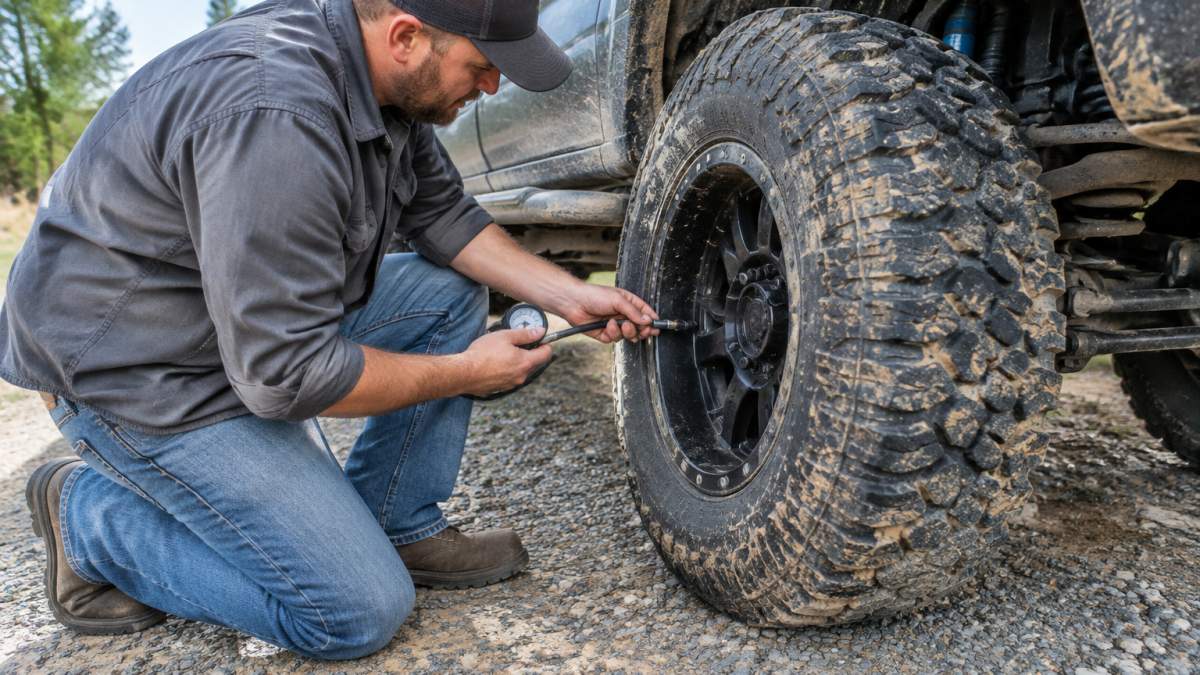
Pressure is not one number for all conditions. It depends on the tire size and load rating, the weight of the vehicle and its cargo, and the terrain you are about to cross. A half-ton pickup with an empty bed and a loaded trailer do not want the same pressure. Before any trip, confirm the cold pressure on all four tires plus the spare, and note the ambient temperature. On a day with a cool morning and a warm afternoon, a tire set cold at 7 a.m. can gain several psi by mid afternoon. That swing is normal, but it means you should set pressure cold and recheck after the tires have sat for a few hours, not right after a highway run.
Airing Down for Trail Use
Airing down means lowering pressure so the tire can flex over rocks and soft ground. The flex lets the tread conform to the surface, which improves traction and smooths the ride. A lower pressure also lengthens the contact patch, which helps in mud and sand. The tradeoff is that a soft tire is easier to damage on sharp rock and more likely to lose a bead at speed.
There is no universal trail pressure. A light Jeep on 33 inch tires and a loaded full size truck on 35s will want different numbers, and the same rig wants different pressures for rock, sand, and mud. Start from the tire maker's recommended off-road range for your tire and load, then adjust in small steps of two to three psi and test the result on the terrain. Carry a gauge and check each tire after you air down, because a single low tire changes how the vehicle tracks and can hide a slow leak.
Watch out: do not air down so far that the bead can pop off the rim, and keep speed low and avoid hard cornering until you are back to normal pressure. A tire that loses its bead on the trail can strand you and damage the wheel.
Reinflating Before Returning to Pavement
Put the air back in before you hit the road. A tire run at trail pressure on pavement flexes far more than it was designed to, heats the tread and sidewalls quickly, and wears unevenly. It also handles poorly and can overheat on a long highway drive. Use a portable compressor rated for your tire size and inflate each tire back to the cold pressure for your load, checking with the gauge as you go rather than trusting the compressor's built in dial. Give the compressor time to cool if you are filling large tires, and recheck all four plus the spare before you pull onto the highway. If you tow, confirm the rear pressure for the tongue weight you are carrying, because a loaded rear axle needs more air than an empty one.
Pressure changes how your tires perform and how long they last, so the article breaks down the key settings to know.
| Situation | Pressure guidance | Key risk |
|---|---|---|
| Normal driving | Cold pressure from door placard or tire maker | Wrong pressure wears tread unevenly |
| Airing down for trail | Tire maker's off-road range, adjust 2-3 psi steps | Bead can pop off the rim |
| Returning to pavement | Reinflate to cold pressure for your load | Overheating and poor handling at trail pressure |
| Towing | Confirm rear pressure for tongue weight | Loaded rear axle needs more air |
Step 2: Rotate Off-Road Tires on a Regular Schedule
Front and rear tires wear at different rates, and so do the tires on the left and right of the same axle. Rotating them evens out that wear.
A practical rule is to rotate every 5,000 to 7,000 miles. If you tow a trailer or carry heavy loads, rotate closer to 5,000 miles. Write the mileage down when you rotate so you know when the next one is due.
Rotation also gives you a chance to look at each tire closely, which makes it easier to catch problems early.
READY TO BUILD YOUR DREAM TRUCK? →
Step 3: Measure Tread Depth and Spot Uneven Wear
Tread depth tells you how much life is left, and measuring it correctly is the difference between catching a problem early and discovering it after a blowout. Check depth monthly with a tread depth gauge, and measure at three points across each tire: the outer shoulder, the center, and the inner shoulder. Do this on all four tires and the spare.
Tread depth minimums vary, and off-road tires often start with deeper tread than street tires, so the usable life is longer but the wear pattern matters more. Use the tire maker's published replacement criteria as your guide, and treat the legal minimum as a floor, not a target. A common pattern is to replace off-road tires well before the legal minimum because wet traction and trail grip fall off sharply as the tread wears.
Watch for these patterns and what they usually mean:
- Edge wear on both shoulders: Often caused by low pressure or an overloaded vehicle. Check pressure cold and confirm the load is within the tire's rating.
- Center wear: Often caused by overinflation or by running a light load at full pressure. Reduce pressure to the placard for your actual load.
- Cupping or scalloping: Can point to worn shocks, a bad ball joint, or an alignment issue. Have the suspension and alignment checked before the next rotation.
- One-side wear: Often a sign of an alignment problem, especially after a lift kit or suspension change. A lift changes camber and caster, and without a proper alignment the inside or outside edge can wear fast.
- Feathering across the tread: Can indicate toe misalignment or worn steering components.
If you see uneven wear, check pressure first, then have the alignment and suspension looked at. Fixing the cause keeps new tires from wearing the same way. A lifted truck that sees a mix of clay trails and highway miles is a good example: the lift changes geometry, the clay packs the tread, and the highway miles heat the shoulders, so an alignment check after any suspension change is cheap insurance against a set of tires wearing out early.
Keep a simple log of depth readings by tire position and date. A tire that loses depth faster than its neighbors is telling you something about pressure, alignment, or how the vehicle is loaded, and the log makes that pattern visible before the tread is gone.
Step 4: Inspect Tires for Damage After Every Trail Run
Off-road tires are tough, but they can still get cut, punctured, or cracked. Make a habit of looking over each tire after every trail outing.
Check these areas:
- Sidewalls for cuts, bulges, or cracks
- Tread for rocks, sticks, or nails
- Valve stems for leaks or damage
- Bead area where the tire meets the rim
Small punctures can often be repaired, but sidewall damage usually means the tire needs to be replaced. Catching a problem early is far cheaper than dealing with a blowout on the trail.
Step 5: Clean Mud and Debris Without Damaging the Rubber
Mud and grit can hold moisture against the tire and hide cuts. Rinse the tires after muddy runs and scrub with a soft brush and a cleaner made for rubber.
Avoid harsh solvents, petroleum-based products, and strong degreasers. They can dry out the rubber over time. A rubber-safe cleaner keeps the tires looking good and helps them last.
Store your tires out of direct sunlight when they are off the vehicle. UV exposure and heat can age rubber faster than normal use.
Keeping Your Off-Road Tires Running Longer Starts Today
Seven steps can seem like a lot, but most of them take only a few minutes. Check pressure, rotate on schedule, measure tread, inspect after trips, and keep the tires clean. Those habits do more to extend tire life than almost anything else.
If you have questions about the right tires for your rig or want help with setup, reach out to our team and we will point you in the right direction.
Frequently Asked Questions
How often should you rotate off-road tires?
Common guidance is to rotate every 5,000 to 7,000 miles to keep wear even across all four corners. If you tow a trailer or camper or haul heavy loads, rotating closer to 5,000 miles is the safer choice, since added weight speeds up wear on the front and rear tires. Pair each rotation with a tread depth check so you can spot uneven wear early. Your owner's manual may list a different interval for your vehicle, so use it as a baseline and adjust for how you drive.
Should you lower tire pressure for off-roading?
Many off-roaders reduce tire pressure, a practice called airing down, to improve traction on sand, mud, and rocks. Lower pressure widens the tire's contact patch, which helps on loose terrain. Airing down only for the trail and reinflating before you return to paved roads protects the tire and the wheel. Driving on pavement with low pressure causes heat buildup, uneven wear, and handling problems. Check your pressure with a reliable gauge before and after every trip.
How do you clean mud and debris from off-road tires?
Rinse the tires with plain water to loosen mud and grit, then scrub with a soft brush and a cleaner labeled safe for rubber. Work the brush into the tread blocks to dislodge small stones and packed clay. Avoid harsh solvents, petroleum-based products, and high-pressure washers held close to the sidewall, since these can dry out or damage the rubber. Dry the tires fully before storing them, and keep them out of direct sunlight when parked for long periods.
How do you inspect off-road tires for damage?
Walk around each tire after a trail run and look for cuts, punctures, cracks in the sidewall, bulges, and embedded rocks or sticks. Run your hand slowly over the tread to feel for sharp objects and check the valve stem for cracks. Look at the tread wear pattern as well, since uneven wear can point to alignment, suspension, or pressure problems. If you find a deep cut, a bulge, or a puncture near the sidewall, have a qualified tire technician evaluate it before you drive further.
